
The challenge
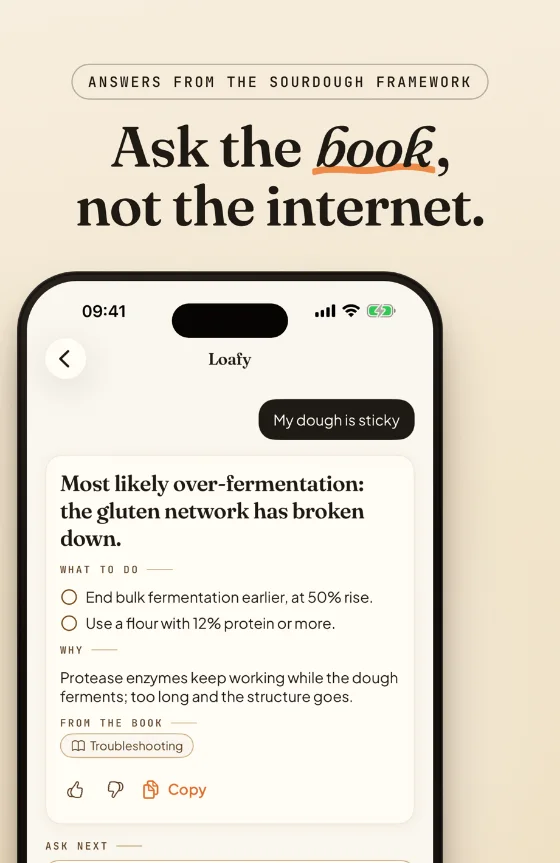
Sourdough bakers get stuck in the middle of a bake: the dough is slack, the starter will not rise, the crumb is dense. Search engines and forums give them ten contradicting answers. The right answer is usually in The Sourdough Framework, my open-source book, but nobody searches a whole book with dough on their hands.
Loafy started in 2025 as a landing page that linked to an AI notebook holding the book. The question for 2026: can an AI answer from the book itself, reliably, in the baker’s own language, at a cost low enough for a free product?
What I built
Loafy, a free baking companion on the web and on iPhone and iPad. Its core is Ask Loafy: a baker asks in their own words; Loafy answers from the book and names the chapter each answer comes from. When the book does not cover something, Loafy says so in its first sentence.
Before building, I wrote down what success means: questions per day, sign-ups from the daily limit, the thumbs-up rate and the cost per day, checked after two and after four weeks. Then I measured instead of assuming. In a blind evaluation of 68 questions, graded against the book by an AI judge, the existing retrieval pipeline scored 7.34 out of 10 and missed answers the book contains. The whole book in context, in the pipeline that went to production, scored 9.65. The cause was retrieval, not the model, so retrieval went. The model itself was chosen the same way: 17 models graded blind against the book, the winner picked on real questions from real bakers, and switched twice in six weeks when the evidence changed.
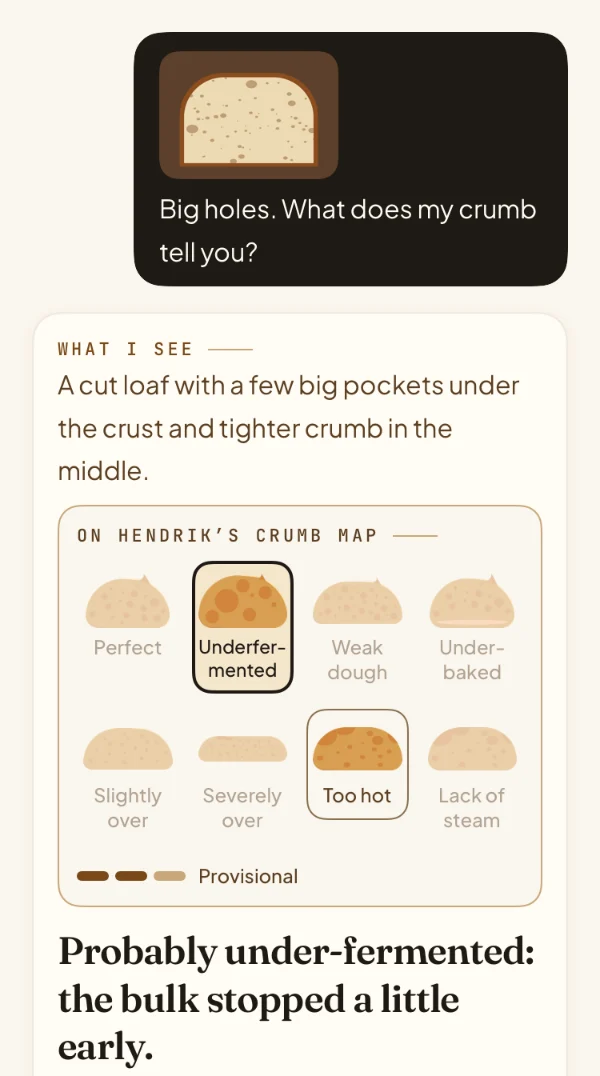
Around Ask Loafy sit the tools a baker needs on the day: the crumb check for a photo of the cut loaf, a bake planner that works backwards from when you want bread, guided first bakes, bread and pizza calculators, and a bake journal that Loafy reads back to the baker next time. Guardrails were set before launch: daily question quotas and hard daily cost caps.
The result
Since Ask Loafy went live in September 2026, it has answered 1,500+ questions from bakers, at under 1 cent of model cost per answer. Since mid-October every answer names the chapter it comes from. 690+ bakers in 70+ countries have registered and logged 750+ bakes in their journals, and the iPhone and iPad app has been in the App Store since October 2026.
That is the path an AI proof of concept takes in your company: success defined before the first line of code, options tested blind on your own material, a system in production within weeks, and the cost of every answer on record.
For the Head of IT
- Stack: Ruby on Rails with PostgreSQL and Hotwire on the web, a native SwiftUI app on iOS, one API for both with streamed answers, self-hosted in the EU. Models are called through one gateway, so the model is a configuration choice, not a rewrite.
- Evidence on record: every answer is stored with its model, tokens, cost and latency; the median full answer takes about 6 seconds. 7,500+ automated tests run on every change to the web app, 1,300+ on the iOS app.
- Verify it yourself: ask Loafy a question at loafy.ai/ask, and read the book it answers from at github.com/hendricius/the-sourdough-framework.